
| Routine element | Starting point | Planning use |
|---|---|---|
| Master schedule | Time accounted for in 15-minute increments | Build one weekly grid for school, work and activities before layering in routines. |
| Household bedtime | Move up by 15 to 30 minutes | Try it first when mornings run late, then adjust for each child. |
| Morning and evening | A regular routine for each | Anchor the day at both ends so the middle can flex. |
| Calendar margin | Time not allocated to anything | Leave gaps so one late event does not push everything back. |
| Family meetings | Regular, so everyone knows the activities | Use them to walk through the week and share the load. |
| Special family night | One night a week | Fix the evening in the calendar so it survives a busy week. |
| Date night at home | Once a week with a spouse | Keep it separate from family night so each gets its own slot. |
| Comparing calendars | On a regular basis with a spouse | Do it before the week begins so clashes surface early. |
These figures come from FamilyLife’s ideas for busy parents and Whole Family Living’s scheduling guide.
Family routines for busy moms work best when they are few, written down and shared: a regular morning and evening routine, chores matched to age, and one protected family night each week. Start with bedtime and mornings.
If you want one place to display the plan, the Family Command Center: Simplify Routines, Reduce Chaos, And Stay On Track In 2026 – Revolucionmama guide shows how to keep the calendar, chores and reminders where everyone can see them. The sections below move from the planning framework to mornings, bedtime, chores, family time and the at-home day, so you can begin with whichever part is hurting most.
Building the routine framework
A routine that works starts with a visible schedule, a small number of fixed anchors and some deliberate slack. Everything else in this guide hangs on those three things.

Start with a master schedule
Whole Family Living describes a master schedule in which all of your time is accounted for in 15-minute increments. For a busy household that grid is the foundation: it shows where school runs, work hours, practices and meals collide before they collide in real life. You do not need to fill every block with a task. The point is to see the week as one picture rather than as a series of surprises.
Once the grid exists, add routines in a particular order. The guide recommends developing a regular routine for your morning and for your evening. Those are the two parts of the day you control most, and they set the tone for everything between them. Resist the urge to schedule the afternoon in the same detail until the two ends of the day are stable.
Treat planning as its own job
Planning tends to be squeezed into the gaps, which is why it so often does not happen. A large-family routines guide from Your Unbusy Life argues that you have to treat planning like its own separate chore. In practice that means giving it a set time and a place on the calendar, not hoping for a spare moment in the car.
If you share parenting, FamilyLife’s advice is to compare calendars with your spouse on a regular basis. That keeps one adult from becoming the only person who knows where everyone needs to be. It also makes it easier to divide drop-offs, appointments and evenings fairly.
Plan margin and hold family meetings
FamilyLife also recommends planning margin in your calendar, meaning time that is not allocated to anything. Margin is what lets a spilled drink, a missing shoe or a late meeting stay a small problem. If your schedule has no gaps at all, the first routine to add is an empty block, not another activity.
The same source suggests scheduling regular family meetings so everyone is aware of all of the activities. A short meeting works well for reviewing the coming week, asking who needs what, and handing out tasks. Children who have heard the plan are less likely to be caught off guard by it, and they have a place to raise problems with the chore system you build later.
Choosing where to start
- Mornings are the daily pain point: begin with the bedtime shift and a short, repeatable morning sequence, covered in the next section.
- Evenings feel chaotic: start with a fixed bedtime sequence and a short kitchen reset, covered in the bedtime section.
- Chores fall on you alone: start with an age-matched chore list and a chart, covered in the chores section.
- The family rarely connects: start with a weekly family night and one-on-one time, covered in the family time section.
Pick one of these, run it until it feels automatic, then add the next. Several changes at once usually mean none of them stick.
School mornings and daytime routines
Calmer school mornings come from two moves: an earlier household bedtime and children taking over parts of the morning work themselves. A tidy checklist helps, but it cannot replace either.
Shift the evening to ease the morning
Whole Family Living suggests shifting your household bedtime up by 15 to 30 minutes to ease mornings. That is a range to test, not a target to hit on the first night. If your mornings are already close to working, the smaller shift is the more sensible one; if everyone is dragging, try the larger one and watch for a few days whether wake-ups improve. The shift only helps if the evening routine in the next section actually fits inside the new time.
Hand over the morning tasks
Mornings get lighter when children own tasks that parents currently do. Mommy Made That lists packing their own backpack for school or other activities as a chore for ages 5-7, and The Savvy Mama lists making snacks and their own lunch for ages 7-9. Both are sensible hand-offs because they remove work from you while giving the child a clear job that happens at the same point every day. You can see both in the age table in the chores section, and the full sources are Mommy Made That and The Savvy Mama.
When children pack lunches, a short note makes the task more appealing for them to take on and for you to supervise. The 50+ Quick Kids Lunch Note Ideas That Brighten School Days (Fun, Short, and Encouraging) – Revolucionmama guide gives you ready-made lines. For the meal itself, the Healthy Breakfast Ideas for Kids: 25 Quick, Tasty Recipes And Morning Tips For Busy Families (2026) – Revolucionmama guide covers options that suit a rushed start.
A sample school-morning sequence
Use the order below as a template and adjust it to your own household. Keep the sequence the same every day, because repetition is what lets children run it without you.
- Wake and dress: clothes chosen the evening before, so no decisions are needed.
- Breakfast: something simple that a child can help assemble.
- Pack up: backpack, lunch and any notes by the door, with older children doing their own.
- Final check: a quick look at the calendar or family board for anything unusual that day.
- Leave: shoes, coats and out the door, with a margin built in for the unexpected.
If one step keeps causing trouble, fix that step rather than redesigning the whole sequence. Often the cause is something that should have happened the night before.
Daytime routines with little ones
Children who are not yet at school need rhythm too, but the anchors are meals, rest and play. When the day needs filling without a screen, the Easy Toddler Activities: 25 Simple, Screen-Free Ideas To Entertain And Teach In 2026 – Revolucionmama list, the Indoor Toddler Activities: 25 Fun, Low-Prep Ideas To Keep Little Ones Busy Today – Revolucionmama list and the Toddler Sensory Activities: 25 Hands‑On Ideas To Boost Play & Development At Home (2026) – Revolucionmama list all work as ready blocks you can slot into the gaps. For snack time with a selective eater, see Healthy Snacks For Picky Toddlers: 25 Simple Ideas That Actually Get Eaten – Revolucionmama.
Bedtime and evening routines
A good evening routine is short, ordered the same way each night and finished with the kitchen and the next day’s bags already dealt with. Its job is to make the morning easier, which is why it belongs in the plan before anything else is added to the evening.
Set the household bedtime
The bedtime shift described earlier only works if the evening has a defined shape. Whole Family Living’s advice to develop a regular evening routine is the key: pick a sequence such as dinner, tidy, bath or wash, story, lights out, and repeat it in the same order. Predictability does more than a perfectly tuned clock time, because children learn what comes next without being told.
When children are different ages
Households with several children rarely get everyone to bed together. Your Unbusy Life says that with a large family you have to get a little sneaky about your bedtime planning, which is a fair description of the problem. A practical approach is to stagger the sequence, so the youngest start first and older children have a later wind-down of their own, while shared steps such as tidying stay at a fixed point.
For toddlers specifically, the Calm Nights: A Simple 20–30 Minute Bedtime Routine For Toddlers (2026 Guide) – Revolucionmama guide lays out a short sequence you can copy and adjust.
Close the kitchen and the day
The best evening routines finish by removing tomorrow’s friction. A short nightly reset of the kitchen means breakfast starts on a clear counter, and the kitchen closing checklist gives families a quick order of tasks to follow. Combine it with packed backpacks and clothes laid out, and the next morning has far less to catch on.
Chores and chore charts
Chores work best when each task matches what a child can reasonably do and when the chart makes the week visible. The tables and lists below turn the supported age guidance into decisions you can use at home.
Which chores suit each age
No list replaces your knowledge of your own child, but the age bands below give a sensible starting point. Treat the ranges as overlapping: a child at the top of one band can usually take on something from the next.
| Age range | Chore | Planning use |
|---|---|---|
| Ages 1-3 | Put toys back in the toy box | Pair with a regular tidy-up point at the end of play. |
| Ages 2-4 | Pick up toys after playing | Make it a routine so it becomes a habit rather than a request. |
| Ages 4-6 | Make the bed in the morning, without changing sheets; set the table for meals | Leave the sheet changing to you for now, and give mealtime setup a fixed place in the evening routine. |
| Ages 5-7 | Pack own backpack for school | Move this to the evening or morning checklist to take a task off you. |
| Ages 7-9 | Vacuum carpets and rugs; sweep and mop hard floors; make snacks and their own lunch | Suits children ready for multi-step tasks; supervise the first few attempts. |
| Ages 10-12 | Mow the yard, with a recommended minimum age of 12 | Wait until 12 even if a younger child asks; give younger ones tasks from the lower bands. |
| Ages 13-18 | Prepare the grocery list and go grocery shopping | Gives older children real planning responsibility for the household. |
The age bands come from The Savvy Mama’s chores guide and Mommy Made That’s age-appropriate chore list.
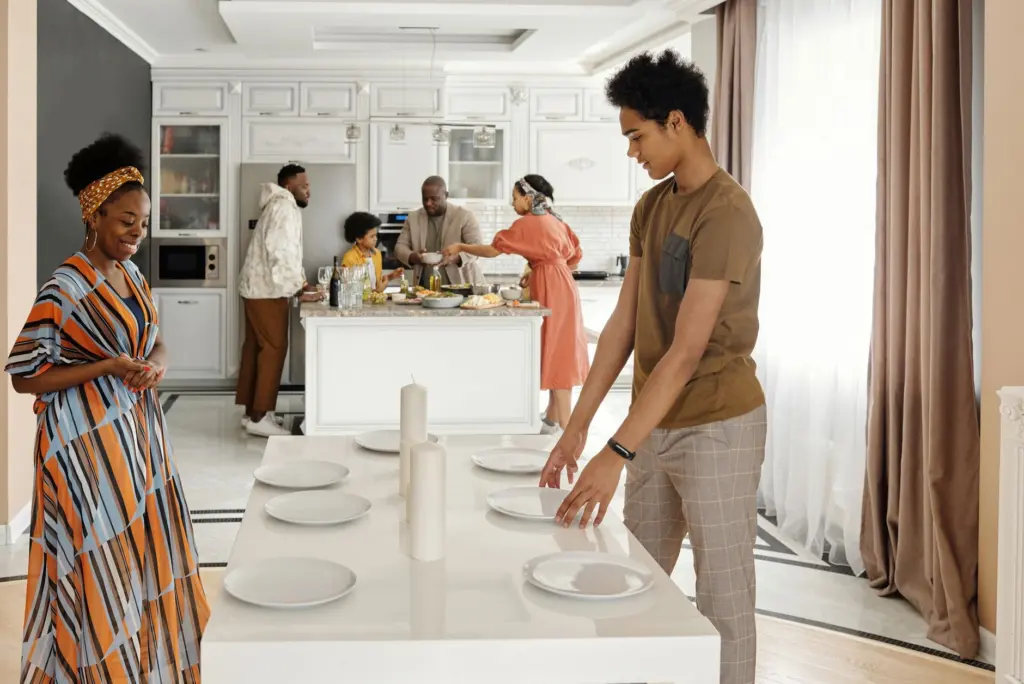
When you add a chore, add it to a place in the day, not just a list. Setting the table belongs before dinner, a backpack belongs at the end of the evening routine, and toy pick-up belongs after play. A chore without a time attached is the one that gets skipped.
Using a chore chart
The Savvy Mama notes that chore charts can help you keep track of the chores and plan each week. That is the real value of a chart: it makes who does what visible, so you do not have to remind and so children can check for themselves. Put it where children pass it daily, such as the refrigerator, and keep it simple enough to read at a glance. If you want ready-made layouts, the Printable Chore Charts For Kids: Simple Templates, Rewards, And Routines To Build Responsibility In 2026 – Revolucionmama guide has templates to start from.
Rewards, allowance and screen time
Rewards are optional, and the chart works without them. If you do use them, choose a system and stay with it. The Savvy Mama gives two examples from its own household. One is a sticker system in which washing dishes earns 1 sticker and washing, folding and putting away laundry earns 2 stickers, with 20+ per week needed for rewards. The other is a money budget of $0.25-$2 per chore, with a discussion about how much goes to savings.
The same source also describes trading chores for an hour of extra screen time or staying up an extra 30 minutes. These are examples of what one family does, not rules, and they carry a trade-off: using screen time or later bedtimes as currency can work against the sleep and screen limits you may want for other reasons. If screen time is already a point of friction, settle the wider limits first with a family media plan and keep rewards for chores to something else.
Older children and teenagers
As children grow, the best chores shift from tidy-ups to jobs with real consequences, such as cooking, shopping and yard work within the age limits above. Resistance is common at this stage, and the practical answer is usually to involve the teen in choosing tasks. If that is your situation, our guide on how to get teenager to do chores goes into the approach in more depth.
Quality time as a family
Quality time happens when it is put on the calendar, and the supported ideas are simple: a fixed family night, time for the couple, and one-on-one time with each child.
A weekly family night
FamilyLife recommends choosing one night a week for special family activities, with the example of a night named Terrific Thursday. A named night does two things: it becomes something children expect, and it gives you a ready answer when other commitments try to claim the evening. Pick the least overbooked night and protect it. If you need ideas, the options range from a movie evening in the Family Movie Night: 25 Easy Ideas & Simple Steps To Create Unforgettable Evenings In 2026 – Revolucionmama guide to competitive evenings in 12 Best Games For Family Game Night In 2026 — Fun Picks For Every Age – Revolucionmama.
For nights when nobody wants to leave the house, the Fun Family Activities At Home: 30 Easy Ways To Bond, Play, And Learn In 2026 – Revolucionmama guide offers low-effort ways to spend time together.

Time for the couple and for each child
FamilyLife also advises a date night at home once a week with your spouse. At home matters: it removes the cost and the babysitter, and it still marks the time as protected. Keep it separate from family night, because the two serve different relationships.
Sibling relationships benefit from time that is not shared. The same source suggests creating one-on-one time for each child to do something fun with just Mom. In a household with several children this is the item most easily lost, so schedule it as you would any appointment. It does not need to be long or costly; the aim is that each child has an occasion on which they are the only one in focus.
Choosing which to protect first
If you can only manage one, choose by need. A family that rarely sits together should begin with the weekly family night; parents running on empty should start with the couple’s evening; a family with a child who seems overlooked should begin with one-on-one time. Review the choice at your regular family meeting and change it when circumstances do.
Special days and travel
Routines bend around holidays, birthdays and trips, and a little planning keeps the structure from collapsing. These are the moments to relax the schedule deliberately rather than abandon it.
For toddler birthdays, the Toddler Birthday Activities: 10 Easy, Low-Stress Ideas To Delight Little Ones In 2026 – Revolucionmama guide keeps the celebration manageable. In the holiday season, 30 Simple Toddler Christmas Activities To Spark Joy This Holiday Season – Revolucionmama offers a set of ideas that fit around naps and meals. When the routine moves to an airplane, Toddler Plane Activities: 30 Quiet, Engaging Ideas For Calm Flights In 2026 – Revolucionmama helps you plan the hours in the air. Return to your normal bedtime sequence as soon as the disruption ends, since it is the quickest way to restore the rhythm.
Routines for the parent at home
Parents at home need a routine for themselves as well as for the children. The structure of the day is the same: a fixed start, protected margin and a deliberate end. The difference is that the calendar has to include your own time.
If you are weighing the role itself, Being A Stay-At-Home Mom: Practical Strategies, Self-Care, And Finding Purpose In 2026 – Revolucionmama covers practical strategies and self-care. For families considering income from home, 30 Flexible, Legit Stay-At-Home Mom Jobs You Can Start In 2026 – Revolucionmama and Side Hustles That Work For Stay-At-Home Moms In 2026: Flexible, Lucrative Ideas You Can Start This Month – Revolucionmama describe options that fit around the household schedule. Whatever you decide, put the work hours on the master schedule and treat them as fixed, in the same way as school pick-up.
Frequently asked questions
Is there a set age for children to do their own laundry?
No fixed age is given. FamilyLife says to teach children to do their own laundry on an age-appropriate basis, so begin with the steps your child can manage and add more as they grow.
Why should planning get its own time slot?
Your Unbusy Life says to treat planning like its own separate chore. If it has a slot on the calendar, it happens; if it is left for spare moments, it usually does not.
How do I handle bedtime when children are different ages?
Expect to stagger it. Your Unbusy Life notes that with a large family you have to get a little sneaky about bedtime planning, so give younger children an earlier start and keep one shared step, such as tidying, at a fixed point.
Why bother giving young children chores?
Mommy Made That says chores help children feel like they are contributing to the family unit, and FamilyLife notes that children can make major contributions to the operation of a household. A small task is a sensible way to start.